Cold storage 100kW Solar Installation: A Green Solution to Jammu and Kashmir
In snow-capped valleys, apple orchards of Jammu and Kashmir, where temperatures drop to -20 C in the winters, it is a war against nature in order to preserve perishable commodities. They have cold storage facilities where juicy apples and saffron, or dairy and vegetables are stored but the failure to supply reliable grid power and skyrocketing energy charges frequently results in spoilage and losses. Go solar: clean and durable energy source which is changing the chilly chain infrastructure of the region. Solar installations with power of 100kW that can produce approximately 400 units per day in the sunny conditions of J&K is a lifeline. This arrangement will guarantee energy autonomy, money saved and less food discarded since the solar potential of the Union Territory was rated the second highest and has 2,218 hours of sunlight a year. India has a target of 500GW of renewables by 2030 and rooftop solar of 344MW is being led by the JAKEDA agency in J&K with 100kW system becoming a feasible move to cold storages
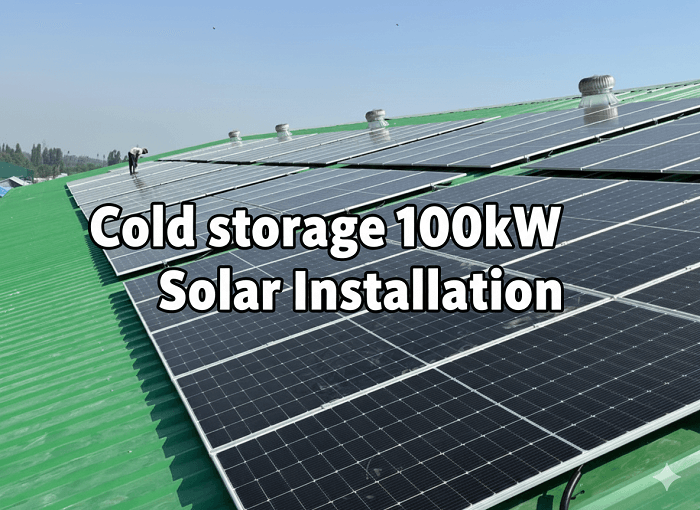
Real-World Project - This analysis is not merely theoretical. A 100 kW solar plant has already been successfully installed at Fresko Cold Chains in Jammu and Kashmir. The system is a fully on-grid installation, designed primarily to reduce the cold storage’s electricity expenses. The plant generates an average of 400 units per day under local sunlight conditions. Since the facility operates on the grid without batteries, the entire setup focuses on cost optimization and efficient consumption of solar power during peak daytime operations.
The Cold Storage Jammu and Kashmir Cold Storage Challenge
The agricultural industry of Jammu and Kashmir is based on horticultural high-value crops, the main crop is apples that earn 3,000 crore per year, but losses post harvest remain in the 20 to 30 percent range because of poor cooling. Conventional cold storages depend on diesel generators or unstable grid power, when outages can raise temperatures to 0C spoilage in hours. In the remote locations such as Kupwara or Baramulla, diesel is priced 100 /litre higher, and grid rates have increased by 15% in 2025. An average facility of 5,000 tonnes swallows 50-100kW an hour of compressors, fans, and pumps adding 80-50 lakh of 50-80 lakh a year to the bills.
Solar addresses this head-on. In contrast to fossil fuels, it uses the clear skies of J&K, 4.5-5.5 kWh/m 2 /day of irradiance, even in cold conditions, when the reduced temperature increases panel efficiency by 0.5 per cent per degree below 25 C. In the case of cold storages, it represents stable 0-4C conditions, which increase the shelf life by 2-3 weeks, and reduce the loss by 15-20%. While other cold storages may explore hybrid or floating systems, the Fresko Cold Chains project uses a straightforward on-grid configuration.
Why 100kW? Sizing for Efficiency
The 100 kW system at Fresko Cold Chains has the right price-point on the medium-sized cold storages (2000-5000 tonnes capacity). It charges 70-80 percent of daytime loads. Expect 1.2-1.4 lakh units in a year, which is sufficient to serve compressors (60kW) and evaporators (20kW), and send the excess to the net metering market.
Actual System Specifications - Fresko Cold Chains Project
- Solar Panels: Adani 540W bifacial modules, offering higher yield due to rear-side reflection in snow-rich regions.
- Inverters: K Solare make, with 2 × 50 kW on-grid inverters supporting the total 100 kW system.
- Redundancy Advantage: Even during extreme conditions, if one inverter shuts down, the plant continues operating at 50% capacity, ensuring uninterrupted partial support to cooling operations
- Frame: Snow-load certified (150kg/m 2) galvanised steel racks.
- Tracking: IoT application to track real-time temp/humidity notifications.
The installation is on 5,000-6,000 sq ft rooftops, and tilted south at 30-35. Cold climate perks? Ice cream works better during freezing, and snow melting facilitates self-cleaning.
Cost Analysis: Investments in Future
A 100kW industrial solar system is estimated at 30-60 lakh of 30,000-60,000/kW in 2025, which is a 10% reduction since 2024 because of the PLI scheme panels. For J&K cold storages:
- Panels: 18-20 lakh (Tier-1 brand such as Waaree or Adani).
- Structure, Wiring and BOS: 5-6 lakh (earthing, cables, lightning protection).
- Installation & Approvals: 3-5 lakh (2-3 weeks, with JAKEDA net metering).
Total: ₹35-45 lakh post-subsidy. J&K is a “special category state under MNRE and provides 70% benchmark subsidy (until 21 lakh in systems over 10kW through RESCO mode). PM Surya Ghar charges 18000/kW on rooftops, but there is an industrial limit. State incentives through JAKEDA cover 20-30 percent higher, that reduces to the effective price of 20-25 lakh. Financing? Green loans: Green loans are available at the rate of 78% interest, which is either borrowed in SBI or IREDA and repaid within 4-6 years.
ROI glows: Save 8-12 lakh / year at 7/unit tariff. Add net metering credits (3-4/unit export), and depreciation (40 percent accelerated in the case of MSMEs), and IRR will be 18-22. Lifetime savings of more than 25 years are in excess of 2 crore.
To Know More: 100kW Solar Panel System: Cost, Installation, and Benefits in India
Design: Technical: Proof and Dependable
Winders in J&K require solid design. Anti-PID coated monocrystalline panels are resistant to snow and hail (IP68). Hybrid inverters automatically go to grid/diesel in the case of extended clouds, and MPPT optimises low-light performance.
Challenges ?
In December-January, yield decreases 10-15% due to snow cover, which is controlled by snow mats or clearing. Above 1,500-2,500m are high altitudes, which imply that the thinner air increases output by 5 per cent however wind/snow forces demand reinforced mounts (BIS-certified). Example: A 50kW pilot at the apple storage at Anantnag reduced the consumption of diesel by 80 per cent.to keep the temperature at 2C with a minimum of -10C nights.
Environmental Contamination and Ripple Effects
Solar reduces the carbon footprint of cold storage: the diesel produces 2.5kg CO2/kWh of carbon dioxide, whereas the solar has an almost zero footprint. In J&K, 100kW would offset 100 tonnes of CO2 annually, which will help the UT achieve net-zero. On the economic side, it generates 20-30 local jobs (installation, maintenance), and increase incomes of farmers by 20-30 percent through improved prices. Srinagar pumps are solar-powered, and the ripple is 70per cent, amounting to ₹50 crore industry revenue.