Common Solar Panel Myths in India
Electricity costs are rising in India by a bit each year, but many homeowners are still reluctant to get solar. If you ask, "why?," the answer is seldom financial. It is typically a few solar energy myths that have been around for more than a decade since the industry has shifted to new technologies. This guide takes you through the most stubborn solar panel myths that are currently around in India, and helps you know what's really happening in 2026.
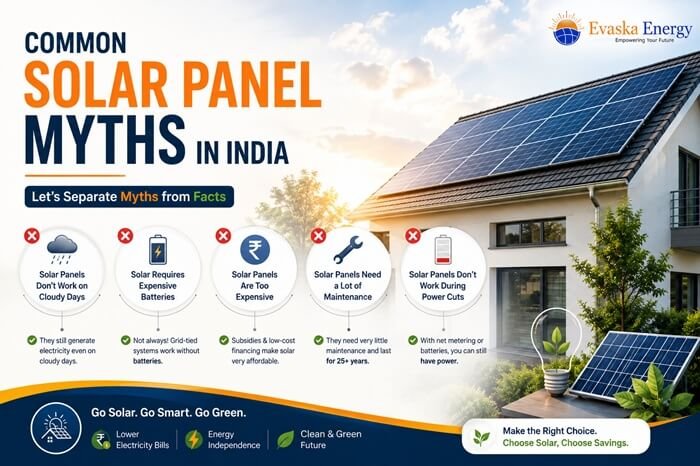
Common Solar Panel Myths in India
The majority of myths surrounding solar panels in India originate from the early 2010s when solar panels were indeed costly, and the efficiency was not as high as it is today, in addition to the fact that many installations were carried out by local vendors lacking after-sales service. It stuck with them. But the technology, pricing and service quality have all evolved significantly since then and the misgivings people acquired from a neighbour's bad experience a decade ago have not been updated. Here are the facts as they stand.
Myth 1: Solar Panels are too expensive
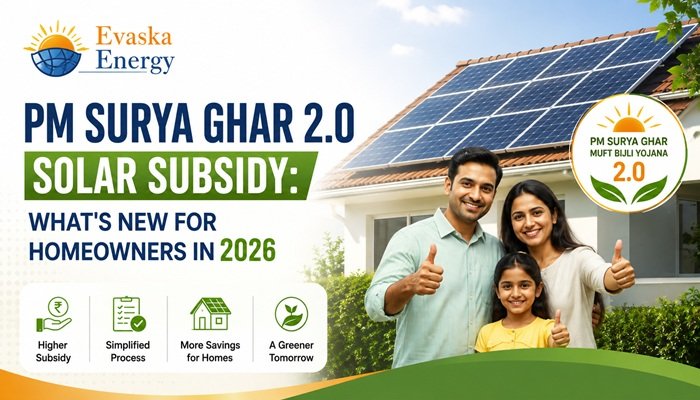
It was certainly the case around 2012, when the price of a 3 kW system was as high as ₹10 lakh. Since then, the price of panels has dropped significantly and the central government has now introduced the PM Surya Ghar Muft Bijli Yojana that provides a subsidy of up to ₹78,000 for those who qualify for residential systems. Introduce zero-cost EMI options and solar loans by banks and NBFCs and the initial price tag that made solar inaccessible for most households has been reduced to a large extent.
Myth 2: Solar Panels Do Not Work On Cloudy Or Rainy Days
Panels don't generate electricity from heat, they generate electricity from light. Cloudy skies will allow some sunlight to reach the solar panels, and shade will cause the panels to generate electricity, albeit at a reduced capacity, usually between 30 and 40% less during periods of heavy cloud. India experiences more than 300 sunny days every year on average and the few monsoon months have a negligible impact on annual generation numbers.
Myth 3: Solar Systems require high cost, constant maintenance
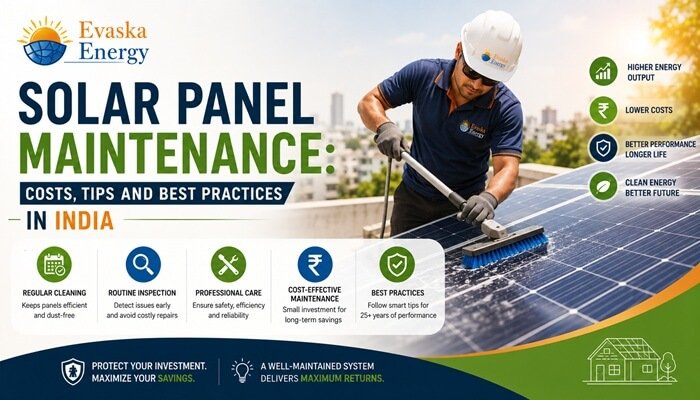
There is very little to wear out or break down in solar panels. A monthly dust wipe down is typically the only maintenance required and reputable installers will provide you with annual maintenance contracts for cleaning, performance checks and inspections, not a monthly expense that you need to pursue.
Myth 4: Solar Panels harm your roof
The problems can occur due to inadequate installation by an unskilled crew, which is a vendor problem and not a solar problem. Most modern setups have panels attached to frames, instead of being drilled into the roofing material, and can be removed from the roof for repairs without ripping anything up. When installed correctly, a mounted system will actually protect the roof below from direct exposure to the sun and rain.
Myth 5: Big House is Necessary for Solar
Solar systems are now available as small as 1 kW, which requires about 100 square feet of roof space that is shaded off. Usually a 2 kW system can provide a sufficient reduction in India's electricity bill and can be placed on a small rooftop. Even apartment owners are not excluded. Group net metering is an option for installing common area loads such as lifts, pumps, common area lighting etc. in housing societies.
Myth 6: Solar Power is not Suitable for ACs and Heavy Appliances
A properly sized system will operate without problems when the load is heavy. A 3 kW system can easily power a 1 to 1.5 ton AC and most household appliances. System sizing is based on actual consumption patterns, and not on a guess, so nothing needs to be switched off to make solar work.
Myth 7: There's No Power at Night or During Outages
There's some truth in it, and it's important to explain it correctly instead of dismissing it. For safety reasons related to the operation of net metering, a typical on-grid system with no battery won't provide power during a power outage. It does this through the use of net metering, meaning that any power that you are using during the day is going to be stored in the grid and then retrieved at night, which means that you will only have one bill. A hybrid system is the answer to this if backup during outages is important to you.
Myth 8: Net Metering Means the DISCOM Pays You for All the Electricity You Generate
Net metering does not mean you are going to accrue money in your bank account. Surplus units exported during the day are credited against units drawn at night, and most states will allow this credit to carry over from one bill to the next. One of the most frequent and expensive system mistakes is to oversize a system that is expecting a cash payout. The better option is to "right size" your system for your usage.
Myth 9: Solar panels are incapable of working in extreme temperatures
Although panels will work at higher temperatures, the output will decrease slightly, with panels performing best at moderate temperatures, but modern panels, especially N-type TOPCon panels, have a low temperature coefficient, which means that the loss in output is not significant. Despite this, India's generally high solar irradiance helps offset this, and makes it one of the most favourable rooftop PV markets in the world.
Myth 10: All Solar Companies and Panels Are the Same
Many homeowners make the mistake of looking for the cheapest quote. The brand and quality of the panel, the quality of the mounting, the warranty on the inverter, the quality of the wiring and after-sales service all differ greatly between the various installers. A lower quality system, such as a smaller tilt angle or inadequate mounting, with a lower cost quote, can result in a system that doesn't work as well as it should or fails well before its 25-year design life. The reputation of the installer is just as important as the equipment.
Why This Matters for Homeowners Today
All these myths were not entirely fabricated. Most of them were correct at a time when solar energy in India was indeed costly, less efficient and with poor support after installation. The only thing that's different is the technology, the pricing, the subsidy structure and the quality of service offered by the existing installers. A system installed today, sized properly and installed by a dependable team of professionals, will generally recoup the cost in 3-6 years, and provide close to 20 years of cost-effective electricity thereafter.