solar energy for EV charging infrastructure
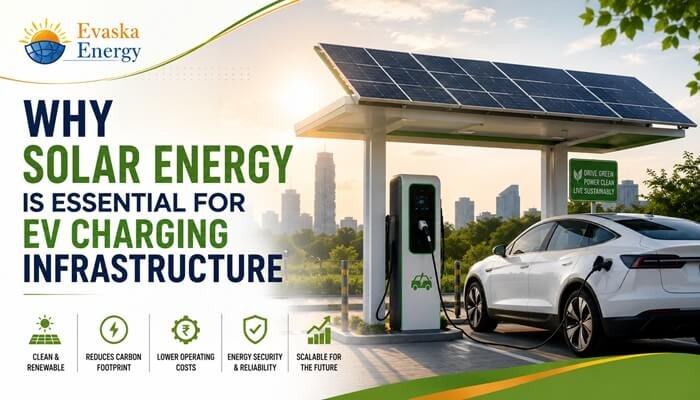
The EV charging ecosystem is expanding in India, but there's a more subtle issue lurking beneath the growth. In many cities, the power grid is already overloaded, and each new charger that is added puts additional strain on it. In India, solar energy is not only a nice sustainability feature for EV charging infrastructure, but it is quickly becoming the financial and technical enabler for large-scale charging networks.
EV Charging Growth Is Pressuring India’s Grid
By mid-2025, India had just over 29,000 public EV charging stations, which is four times more than the number of stations available at the end of the previous quarter.Mid-2025, India's public EV charging stations grew by 4x in 15 months to just over 29,000. This is projected to remain the trend as EV sales grow in two, three and passenger vehicles. However, there is one issue that many people don't consider until they get to scale: grid capacity.
The cost of establishing a single charging station of 50 to 120 kW is ₹20 to 45 lakh and DC fast charging hubs tend to consume loads similar to a small factory. If multiple stations are located on the same feeder, particularly in the afternoon during peak periods, local transformers and distribution lines begin to become stressed. That's where solar comes in, not as a gesture to the environment, but as real load relief to a stressed electrical grid.
Why Solar Fits EV Charging So Naturally
The timing is conducive. A significant amount of public and workplace charging occurs during the day, typically between 10 am and 4 pm, when solar generation is also highest. The peak charging demand in office parking lots, malls and commercial centers occurs at the same time that solar panels are generating the most electricity. This overlap is not common in renewable energy and makes rooftop/Canopy solar the ideal fit for daytime charging loads.
It cuts the single biggest operating cost. Electricity will make up 40-60% of the operating costs of a charging station. The cost of rooftop solar is approximately ₹2.5 to ₹3.5 per unit in high-irradiance regions such as Gujarat, Rajasthan, Tamil Nadu, and Maharashtra, which is significantly lower than the commercial grid tariffs. That difference is what could make or break the profitability of a charge point operator operating on a thin margin in two or five years.
It decreases reliance on erratic or non-existent power grid. DISCOM connections are slow to get and unreliable once installed in many tier-2 and tier-3 towns and along the stretches of highway. With the availability of abundant sunshine in India, most parts of the country receive more than 5 kWh per square metre per day, decentralised solar charging is a viable option where the extension of the grid would take months or simply not be cost-effective.
It reduces peak demand to the grid. Solar-powered stations produce power on site in the day, so they don't have to take as much from the grid when the grid is most stressed. Combined with battery storage, solar-hybrid systems can reduce the reliance on the grid by up to 40% for the operator's bill and in the surrounding area for grid stability.
Government Push Behind Solar-Integrated Charging
In 2024, the Bureau of Energy Efficiency launched the Green Charging Initiative, which mandates that 50% of all new public charging stations be powered by renewable energy by 2026. MNRE has also allocated finances for solar powered EV charging stations under the National Solar Mission and has released draft guidelines that provide capital subsidies for eligible projects. A number of states such as Gujarat, Uttar Pradesh and Rajasthan have exempted land conversion charges for EV infrastructure that is connected to solar power, while Delhi has implemented time-of-day pricing which makes electricity 20% cheaper during solar hours, specifically to encourage operators to charge EVs during solar hours.
This is something that large players are already developing around. Adani Green Energy and ChargeZone announced their plans to install 1,000 solar-powered chargers along the Delhi–Mumbai Expressway. Tata Power has been steadily growing its charging network with solar integration from the design phase and not added on later.
Practical Benefits for Charging Station Owners
Besides the environmental benefits, there are a number of tangible benefits to solar integration for those installing or running a charging station:
- Reduce electricity cost per unit, improve margins on each charging session
- Lower operating costs, which can help to shorten the typical 24–36 month breakeven period for a well-located station
- Defense against escalating commercial tariffs, which are continually increasing each year
- Right to capital subsidy and incentives for renewable power based charging through central and state schemes
- Improved grid application results, as DISCOMs are looking to projects that help to lower net demand on limited feeders.
- Greater access to funding and co-investment from corporate and CSR partners who are more likely to invest in visibly green infrastructure
Challenges that are worth knowing about
Solar-integrated charging does not necessarily mean easy. In dense urban areas, space for large solar arrays is scarce, and many city stations use canopy-mounted solar arrays installed on top of parking areas instead of ground-mounted arrays. Significant upfront cost is required for battery storage because it is necessary to store energy for use after the sun sets or during periods of cloud cover. Today, however, utilisation rates at many public stations are still low, and the economics only play out as EV density in an area matches the number of charging stations being constructed.
All these are good excuses to keep going with solar. They are excuses to do the solar part right, not as an add-on to the design at the end.
The charging infrastructure that powers India's EVs is not simply going to be able to be powered from the grid without putting a strain on the distribution network, especially in the areas where EV adoption is more likely to be high. Solar energy does this in two ways: it lowers the operating cost that is the difference between a charging business' survival and failure, and it decreases the load pressure that is the difference between whether the surrounding grid can support the charging station or not.
For anyone looking to install an EV charging station in India, not thinking about solar power is going to be a big mistake instead of an assurance to save costs. Policy support, the financial aspect, and the solar generation peak hour which coincides quite closely with the charging peak show that everything is aligned in support for it. The two main areas where an accurate estimation of the solar system's capacity is the key to significant savings and a step up in reliability, especially when you are thinking about solar, are actually in the planning stage rather than waiting for you to add it at a later stage.