pm Surya ghar 2 0 solar subsidy
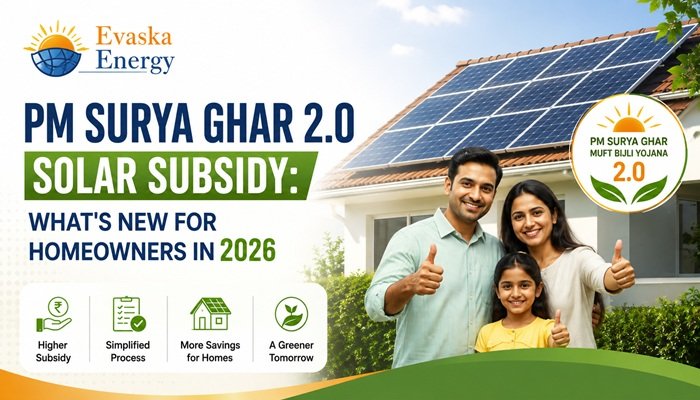
If you have been looking into rooftop solar this year, you've likely heard the phrase "PM Surya Ghar 2.0" and wondered what it means for your application. The truth is, it's not a live scheme just yet. It is a proposed redesign which is being discussed by the Ministry of New and Renewable Energy and the existing homeowners who have applied till today are still under the old PM Surya Ghar Muft Bijli Yojana. This piece separates what's confirmed from what's being talked about.
What is PM Surya Ghar and Where Does 2.0 Fit In?
In February 2024, PM Surya Ghar: Muft Bijli Yojana was launched with a target of solarising 1 crore households by March 2027, and an outlay of ₹75,021 crore. It provides a direct central subsidy for rooftop solar to the homeowner, which is credited to their bank account once the solar system is installed and is net metered.
The PM Surya Ghar 2.0 is a redefined next phase, which has been discussed with MNRE since mid-2026. It is not a notified policy, there is no launch date confirmed and no official subsidy figures have been released. All items relating to 2.0 should be interpreted as "under consideration" rather than "available for application today.
Current Scheme: What is Confirmed and Working at This Time
Let's first take a look at what is already in the works for 2026.
The central subsidy is provided in slabs: ₹30,000 per kW, ₹18,000 per kW for the third kW and a maximum of ₹78,000 per household, irrespective of the size of the system. A 5 kW system still gets the same ₹78,000 as a 3 kW one.
Your connection must be residential, on your name or family member's name and have a permitted load of 10kW or less. The equipment used by your installer should be on the approved list of the manufacturers provided by MNRE and listed on the ALMM. Applications are made through pmsuryaghar.gov.in and the net meter is installed by your DISCOM and the subsidy is credited through direct benefit transfer, usually within 30 working days.
The scheme had reached about 40 lakh solarised households and disbursed over ₹17,900 crore by mid-2026 with several states providing their own top-ups, such as Gujarat's ₹10,000 per kW and Delhi's generation incentive per unit.
What's Being Proposed Under PM Surya Ghar 2.0
Taking cues from the media coverage of the MNRE's 2026 consultations, here are a couple of thoughts. At this time none of these are confirmed benefits.
Generation-linked subsidy: The redesign, the report says, would attach a share of the subsidy to the electricity actually generated and consumed, so that systems that actually generate electricity, not just sit underperforming, would be rewarded.
Battery storage support: The current scheme has no battery subsidy at all. A special incentive for behind-the-meter battery storage is included, which would allow households to store solar power from the day to use at night when the power grid is active. There is no known amount or eligibility at this time.
Residential multi-family rooftop PV: A major deficiency of the current scheme is that it excludes tenants and people living in apartments who don't have an appropriate roof over their heads. The proposed redesign is said to be designed to create a space for shared and community rooftop models.
Digital Solar Passport and quality monitoring: Reports include lifecycle tracking for installed panels, AI-driven quality checks to minimize underperforming installations without anyone realizing it.
Changes to net metering: With rooftop solar installations growing in states like Gujarat, Rajasthan, and Delhi, some DISCOMs already report voltage and reverse power flow on high solar feeders. A generation-linked incentive would probably require an update to the rules for net metering or "net billing," which would give a different value to solar energy that is consumed versus solar energy exported.
Current Scheme vs. Proposed 2.0 Changes
| Aspect | Current Scheme (Live) | PM Surya Ghar 2.0 (Proposed) |
|---|---|---|
| Status | Fully operational | Under MNRE consultation, not notified |
| Subsidy basis | Installed capacity | Reportedly generation-linked |
| Battery storage | No incentive | Dedicated incentive under discussion |
| Renters/apartments | Largely excluded | Shared rooftop model proposed |
| Max subsidy | ₹78,000 (3 kW cap) | No confirmed figure |
| Quality tracking | ALMM listing only | Digital Solar Passport, AI checks discussed |
| Net metering | State/DISCOM-specific rules | Possible net billing revision |
| Timeline | Running since Feb 2024 | No confirmed launch date |
Should you wait for PM Surya Ghar 2.0?
Given there's no confirmed rollout date, this is a math problem, not a guessing game. Each month that you wait on the current scheme is a month of having to pay your electricity bills in full and equipment prices don't drop off quickly enough to make up for that lost savings.
The scheme is currently fully funded, is open for applications and is offering subsidies in a predictable manner. With no announced figures and no confirmation of an upcoming version, the future savings from a policy may not materialize for a long time, and the savings may not be real.
For most homeowners, it is still the better financial option to apply to the existing scheme, if they have a roof ready and their DISCOM connection meets the requirements.
Frequently Asked Questions
Q. Is PM Surya Ghar 2.0 a reality?
Ans. No. Currently, it's a proposed redesign under discussion at MNRE, but no policy has been notified yet and there is no confirmed date for launch.
Q. Does now applying in the current scheme impact my ability to apply for 2.0 later?
Ans. There's no indication of this. If 2.0 does launch, those who have the current version would probably still be able to receive their current benefits, but there is still no official word on that.
Q. Is there any battery subsidy available in the existing scheme?
Ans. No, the existing scheme does not include battery storage subsidy. One of the ideas that are being discussed for 2.0.
Is it possible for apartment dwellers to apply for solar subsidy now?
In most cases only with proper consent of an individual or common roof and society. The proposed changes in 2.0 include a broader shared rooftop access; this is not policy.
Where can I find official updates about PM Surya Ghar 2.0?
Only the official MNRE press releases and pmsuryaghar.gov.in are the official sources. Assume that other reports are the media coverage of the discussions that are continuing.
Will the existing subsidy of ₹78,000 be subject to change in the near future?
An official notification does not indicate that there is a rate change in sight until the scheme's target date of March 2027.