Delhi Solar Policy: Your Zero Bill Guide
In Delhi, the ever-increasing energy bills have pushed rooftop solar to be a popular option for energy self-sufficiency. The Delhi Solar Policy (updated with amendments through 2025) and the national PM Surya Ghar: Muft Bijli Yojana together give a number of households the ability to get near-"zero bill" status - where solar production is so efficient in terms of matching consumption that the household pays out practically nothing or only fixed charges on the bill. By 2026, along with net metering improvements and the availability of various subsidies, households in Delhi stand to make a considerable saving while they help the city reach its target of 750 MW rooftop solar by 2026-27.
This post breaks down the way these measures complement each other, discloses subsidy details, illustrates the zero-bill operation, explains the procedure for applications, and provides the reader with ideas on how to optimize their monetary benefits.
Delhi's "Zero Bill" Model Explained
In Delhi's context, "zero bill" refers to a scenario in which the rooftop solar installation of a household produces the exact amount of the electricity consumption of the home or even more, a surplus being sent back to the grid via net metering. The credits obtained from the energy fed into the grid balance out the amount of future bills so that, theoretically, the household could not have any variable costs.
- It is typical for families using 300-400+ units of electricity per month to achieve zero bills by installing a solar system sized between 3-5 kW.
- Delhi, with its topographical benefits for solar energy absorption (5-5.5 peak sun hours/day), DISCOMs (BSES, Tata Power Delhi) that support renewable energy, provides best conditions for solar energy production.
- Net metering has made energy crediting possible by allowing one-to-one conversion of energy produced to energy consumed at other times: the extra electricity generated can be accounted for monthly or even yearly in many jurisdictions.
In January 2026, DERC issued the Seventh Amendment to Group/Virtual Net Metering Guidelines that, among other provisions, enhanced virtual net metering, reduced the amount of money the DISCOMs had to spend on infrastructure, and made it easier for apartment complexes and single-point supply consumers to join the system.
The Main Attraction: PM Surya Ghar Muft Bijli Yojana
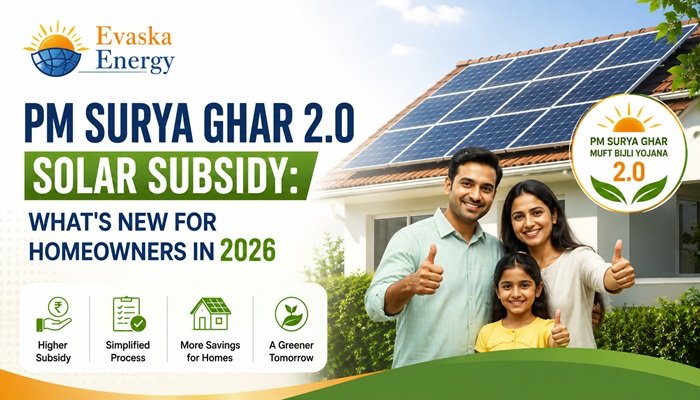
This MNRE program, started in 2024 and still running in 2026, is a scheme aimed at 1 crore households across India, by providing an allowance of up to 300 units free of charge per month by means of subsidized rooftop solar. Subsidy Structure (Residential):
- ₹30,000 per kW for the first 2 kW.
- ₹18,000 per kW for the next 1 kW (up to 3 kW total).
- Max CFA: ₹78,000 for systems ≥3 kW (beyond 3 kW the cap).
For Apartment Societies (GHS/RWA), the limit is ₹18,000 per kW for common areas (up to 500 kW total, ~3 kW per household equivalent).
Submitting a request on the national site: pmsuryaghar.gov.in. Among the benefits are the subsidy paid directly into the bank account after the installation, concessional loans, and vendor facilitation.
The Delhi State Scheme: Further Additions
On top of the central support, Delhi gives the baton of state funding, which has turned it into one of the most favorable locations in India. The main incentives (Delhi Solar Energy Policy 2023, with 2025 amendments):
- (Residential) State Capital Subsidy: ₹2,000 per kW, maximum ₹10,000 per consumer. Generally, this amount is credited on the first electricity bill after system commissioning.
- Generation-Based Incentive (GBI): More money per unit depending on the category of the unit as follows:
- Residential (up to 3 kW): ₹3 per kWh.
- Residential (3-10 kW): ₹2 per kWh.
- GHS/RWA: ₹2 per kWh (up to 500 kW).
- Commercial/Industrial (first 200 MW): ₹1 per kWh.
- Some mention is made that the combined support for a 3 kW system can come up to ₹1.08 lakh (centre ₹78,000 + state additions approx. ₹30,000 in certain cases via DISCOMs/BSES).
Net metering is still very much alive and well, with the recent modification that allows DISCOMs to pay more for the augmentation cost, thus lessening the amount you have to pay.
How Combining Benefits Can Help You Have Zero Bills
Here's a sample case for a regular household in Delhi (monthly consumption of 400 units):
- The proposed setup: 4-5 kW (₹2-3 lakhs cost pre subsidy)
- Central subsidy: ₹78,000 (maximum limit)
- State top-up: ₹10,000 capital + GBI overtime
- Net cost after incentives: 30-40% less
- Production: ~15-20 units/day (450-600 units/month)
- Surplus exports gain you energy credits; GBI further gives you around ₹500-1,500 per month starting.
- Outcome: A bill with zero variable charges + a minimal fixed/demand fee. Lots of people manage real zero with the help of optimization.
For big users (>500 units), 5-10 kW setups + virtual net metering (property sharing) can turn zero bills into reality.
Application Process: Step by Step
- Confirm eligibility: residential consumers under Delhi DISCOMs, adequate rooftop area (free from shadows).
- Sign up on the portal: Go to pmsuryaghar.gov.in or solar.delhi.gov.in. Fill in details, consumer number.
- Pick installer: Select MNRE-approved contractor; obtain feasibility green signal.
- Put in and start up: Installation; DISCOM checks, connects and energizes (net meter setup).
- Grant claim: Bank credits subsidy; state GBI through bills.
- Keep track: Apps help with generation monitoring.
Period: 1-3 months; can even be quicker if DISCOM is helping.
Factors for success and Tips
- Get the right size: Little oversizing for cloudy days/monsoon season.
- Go for quality: ALMM-listed panels (mono PERC/TOPCon), trusted inverter brands.
- Servicing: Keep panels clean once every three months; negligible cost.
- Break-even: 3-5 years with the support of government subsidies (compared to 6-8 years without).
- Problems: In apartments, there is not much room - use community/virtual models instead.
On a national level, Delhi's schemes are outstanding in terms of the combination of benefits, making it possible for solar to be both affordable and profitable.
Take advantage of the sun by putting in solar panels on your rooftop today to enjoy zero bills tomorrow. Keep an eye on the portals for the most recent information as policies are undergoing rapid changes.