Group Procurement Solar Delhi NCR
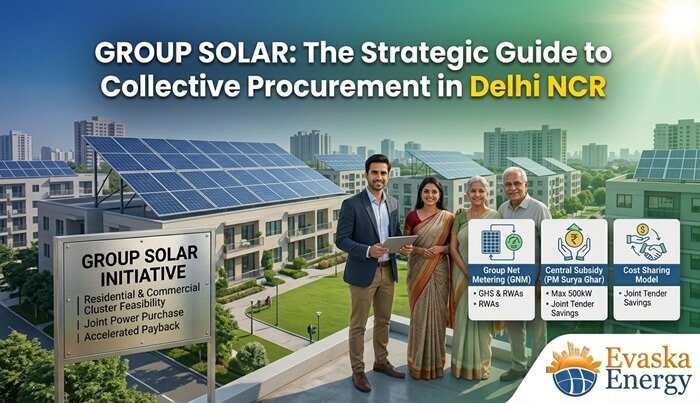
For the same total demand, it is clear that the cost of the combined 1000 kW system is not the same as the sum of the five separate 200 kW systems. This is the fundamental concept behind bulk solar tenders, and a lesser number of corporate buyers in Delhi NCR are using this option than they could.
Why pooled demand leads to better pricing
Solar EPC (engineering, procurement, construction) companies charge for projects in part according to fixed costs, which are not proportionate to the size of the project - for example, the site survey, design, logistics, mobilizing a labor crew, and administrative overhead are all roughly the same for a 100 kW project as for a 1 MW project. The EPC company can spread the fixed costs over a much larger overall capacity when several businesses put their requirements in a single tender, and quotes are generally better as a consequence – better per-kW panel and inverter prices due to bulk equipment orders, one mobilisation rather than five, and one negotiation process rather than five.
For business parks, industrial associations and clusters of SMEs located in the same zone (Manesar, Udyog Vihar, Sector 58 Noida or any industrial belt) this is a simple solution to avail the pricing normally applicable to the utility scale buyers.
Group procurement routes available to businesses
Industry association tenders: Local industry associations or business chambers in Gurgaon and Noida periodically release combined solar tenders, and negotiate a single solar rate for all members of the association that can choose to participate.
Group captive schemes: If a company has a larger load, they can form a group captive scheme to develop or subscribe to an offsite solar plant, share ownership and connect to the grid through open access - ideal for businesses that do not have sufficient rooftop space.
Bulk solar procurement through GeM tenders: For PSUs, Government offices and Public Sector Corporate entities, bulk solar procurement is increasingly being done through GeM, where the demand of various departments/offices are pooled together for a better rate.
Private aggregator platforms: Many solar consulting and aggregation companies now group together the demand from various unrelated companies just to obtain a better price from EPC vendors, without the companies having to be formally associated.
The actual negotiation in bulk tender
The well-designed group tender is more than just a per-kW rate. The items that can be negotiated as a group are:
- Equipment tier - Bulk orders may give access to better brands of panel and inverter (which may not be justified in a single small order).
- Warranty terms - the bigger the combined order, the more leverage to negotiate longer inverter warranties or workmanship terms for all sites.
- Maintenance contracts - usually an AMC (annual maintenance contract) for multiple sites is a lower price per site than individual AMC.
- Financing terms - financing partner and EPC companies may provide better financing terms for the total contracted capacity in a tender, if the total exceeds a threshold.
- Delivery and installation schedules - pooled projects may be able to be sequenced to ensure quicker delivery, as the EPC has agreed to deliver volume, which should be prioritised.
Businesses that are thinking about group procurement will need to take some practical steps.
- Assess aggregation potential – contact your industry association, business park management or local businesses to determine if an existing or new collective solar interest exists.
- Gather load and roof data up front - vendors can more accurately quote, and more quickly, when the total demand and available roof area across participants is known in advance, rather than negotiated site by site.
- Agree on a single technical evaluation criterion before inviting quotes - when tendering, the EPCs are evaluated based on the price and service they provide, not on the fact that they provide different levels of equipment without the tenderer knowing.
- Site specific clauses should be kept separate – pricing and equipment can be negotiated as a group, but site access, structural approval and connection specific issues should be handled on a case-by-case basis per site.
- Even if a combined contract, get the AMC and warranty terms in writing per site to ensure responsibility is clear in case one site has an issue, others do not.
Delhi NCR corporate solar buyers who are negotiating on their own are almost certainly missing out on pricing leverage. Bulk and tender-based procurement (whether by an industry association, a group captive structure or a private aggregator) often results in lower per-kW rates, higher equipment tiers and improved warranty and maintenance conditions, than any individual company could achieve on its own. If companies are thinking of investing in solar in the short term, it may be worthwhile to investigate if there is a group tender that is already active in the area before committing to a single EPC contract.