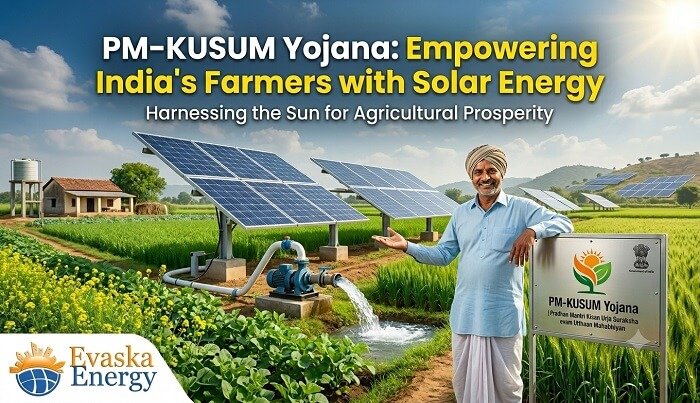
PM-Kusum-Yojana-Solar-Energy-Farmers
One of the major challenges in the agricultural sector in India has been the scarcity of reliable electricity, combined with the high cost of diesel-powered irrigation. The Ministry of New and Renewable Energy (MNRE) launched the Pradhan Mantri Kisan Urja Suraksha evam Utthaan Mahabhiyan (PM-KUSUM) scheme in March 2019 to address both the problems - one of becoming an energy producer from an energy consumer.
The scheme aims to install 34,800 MW of solar power in India's agriculture sector and has a total central financial outlay of ₹34,422 crore. It is one of the most ambitious farmer- centric solar initiatives in the world.
What Is PM-KUSUM?
PM-KUSUM is a flagship government scheme to encourage the use of solar energy in the agricultural sector by providing subsidies on solar pumps, decentralised solar power plants and solarisation of the feeder system. It aims to:
- Decrease the reliance of farmers on diesel and electricity from the grid for irrigation purposes Decrease input costs and farm income
- Enable farmers to generate extra income from selling surplus solar energy to the grid.
- Ensure India's commitment of 40% non-fossil fuel energy capacity under the Paris Agreement.
In short, by making the farmer an "Urjadatas" (energy provider) instead of a mere "Urjayakrit" (energy consumer), PM-KUSUM makes him an energy provider.
Three Key Components of PM-KUSUM
Component A: Decentralised Solar Power Plants (10,000 MW)
This component allows individual farmers, farmer groups, cooperatives, panchayats, Farmer Producer Organisations (FPOs) and Water User Associations (WUAs) to install grid-connected solar or renewable energy power plants of 500 kW to 2 MW capacity on their barren or unused land. Under this plan:
- The plants have to be within 5 km of a power substation to be connected to the grid and the electricity generated will be sold to the local DISCOM through a 25-year Power Purchase Agreement (PPA).
- This will provide a long-term and stable income stream from otherwise unproductive land
- The Farmers who are not able to organise equity can enter into a partnership with a Developer to establish the plant.
Ideal for: Barren land or land not suitable for growing, farmers seeking long-term passive income.
Component B: Standalone Solar Agriculture Pumps (14 Lakh Pumps)
This is the most popular component of PM-KUSUM. It is for the installation of off- grid solar powered pumps in areas where grid electricity is not available, instead of replacing diesel pumps.
- Pump capacity supported: up to 15 HP (revised upward in recent updates)
- Reduces/eliminates fuel costs and compromise in maintenance as compared to diesel pumps
- You may still be able to irrigate in the absence of grid energy and lack of fuel availability to a certain extent.
| Contributor | Share |
|---|---|
| Central Government (CFA) | 30% |
| State Government | 30% |
| State Government | 30% |
In this structure, the remaining 10% acts as the Beneficiary/Farmer. However, the central subsidy is 50% in special category states (North-East, J&K, Himachal Pradesh, Uttarakhand, Lakshadweep, A&N Islands) which means the farmer's share is as low as 20%. Ideal for: Farmers not connected to the electric grid or those with low electrical capacity who use diesel pumps to irrigate their crops.
Component C: The Solarization of Grid-connected Pumps (35 Lakh Pumps)
Component C is on feeder level solarization of existing grid-connected agricultural pumps. Farmers can depend on the reliable electric power during the day instead of relying on the unreliable power that comes at night.
- Farmers can sell excess solar power to the grid, thereby earning extra income
- There has been good response from the farmers in Rajasthan, Maharashtra, Gujarat, Karnataka and Haryana
- Subsidy and loan structure is similar to Component B
Ideal for: farmers who already have grid-connected pumps and are looking for energy security and revenue from excess electricity generation.
Who Can Apply?
PM-KUSUM has a flexible eligibility criterion, which includes a large part of the rural farming community:
Individual farmers (owning agricultural land)
- Groups of farmers
- Farmer Producer Organisations (FPOs)
- Cooperatives and panchayats
- Water User Associations (WUAs)
The scheme is designed to benefit the small and marginal farmers first and foremost, thus ensuring that the beneficiaries are those who need it the most.
Necessary Documents
Documents needed for registering:
- Aadhaar Card
- Copies of land ownership records (Khasra-Khatauni / Jamabandi)
- Bank account passbook copy
- Passport-sized photographs
- Aadhaar linked Mobile Number
Note: There will be no registration fee. Apply only through the official national portal, pmkusum.mnre.gov.in, or the nodal agency website of your state. No site will ask you to pay any money to get a "Kusum ID".
Key Benefits at a Glance
- As much as 90% of subsidy in some states, most farmers only paying 10% upfront Zero fuel costs - solar energy replaces expensive diesel
- Dual income: farm produce + surplus power sold to the grid.
- Productive use of barren land, generate income from land that was previously unused, and Daytime irrigation, no more depending on unreliable nighttime electricity supply.
- Effective investment life is 25-30 years. Effective life of the investment is 25-30 years.
How to Apply
- On PMKUSUM.mnre.gov.in or State nodal agency portal, visit the website.
- Go to PMKUSUM.mnre.gov.in or the portal of the State nodal agency.
- Click on "Registration" and complete the information (Name, Aadhaar, Mobile number, Address)
- Submit the necessary paperwork
- Once you've completed the form, check on your application status online.
- Once approved, the empanelled vendors will proceed to install the system.
In conclusion, PM-KUSUM is more than just a subsidy scheme; it is a shift in the energy usage and energy production in the Indian agriculture sector. It provides a unique set of benefits: reduced expenses, increased profit and sun-powered energy independence - all for farmers nationwide.
For farmers and solar solution providers, it's the perfect time to capitalize on this scheme. Learn about PM-KUSUM, get in touch with your state nodal agency, and start on the path to a solar-powered, self-reliant farm.
If you are looking for professional advice for your solar setup and eligibility for PM-KUSUM, please contact Evaska Energy - Your trusted provider of clean energy solutions.