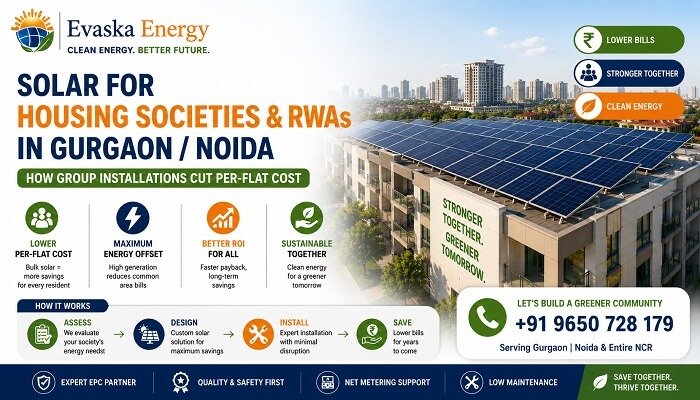
Solar For Housing Societies RWAs Gurgaon Noida
If you live in any large residential complex in Sector 82 Gurgaon or Sector 137 Noida, you will see the same thing on electricity bill each month: common area charges which are continually increasing. There is no choice on the use of lifts, lighting in the corridors, water pumps, air conditioning in the clubhouse, security cabins - none of these is cheap when they are used individually. This is the load that a shared rooftop solar system is designed to address, and one of the few upgrades in which the economics actually get better the more flats that join.
Why "group" changes the math
A single homeowner installing 2-3 kW on his/her own balcony or terrace pays retail price for a small system, which consists of a mounting structure, wiring, and a single inverter, all sized for a small load. A housing society with a 50 kW/100 kW rooftop project for common areas purchases at a different scale. The panels, cabling, structure, and labor are all bought in bulk, which means that the price per kW is considerably lower than a stand-alone home installation. Vendors also fight more for one big contract than for a few smaller ones, thus driving down the quotes even more.
The second saving is not obvious: one set of approvals, one net-metering application, and one inspection cycle for the entire building, as opposed to dozens of individual homeowners applying for each one separately with DHBVN or the Noida Power Company. That's enough to take weeks of back and forth and some paperwork fatigue out of residents' lives.
The actual use of the funds in an RWA
Common area electricity is usually 8-15% of the total maintenance costs of a medium sized society, depending on the number of lifts and the amount of common area lighting. A large portion of the common area load - lifts, pumps, corridor lights, gym, clubhouse - can be covered by a rooftop system sized to meet the daytime load. This can be as much as 60-80% depending on roof area and shadow-free space available. The energy produced during the day (when the common areas consume less energy) is credited against the energy consumed during the night (when the lifts and security lighting consume energy) as it is billed against the society's DISCOM connection, under the net metering system.
The saving then appears as a reduced monthly maintenance charge for all flats - the actual benefit to those who do not use the common areas extensively but contribute an equal share anyway.
How the money is typically distributed
In Gurgaon and Noida, most of the RWAs follow one of three paths:
- CAPEX (society pays upfront) – the society pays for the system out of its sinking fund or from a one-time payment by the residents. Full ownership, full savings from day one, but cash outlay is required.
- RESCO / OPEX model—In this model, the solar company installs and owns the system on the roof of the society without any upfront cost and the RWA pays a fixed per-unit rate for the power generated, which is typically lower than the DISCOM tariff. No maintenance problems for the society, and some savings compared to full ownership.
- Loan-backed CAPEX—the society borrows money (some banks now offer green loans for RWAs) and repays the loan from the monthly savings, which means that the system pays for itself.
On top of state incentives in Haryana and UP, housing societies with common area consumption exceeding a certain limit can also apply under PM Surya Ghar's group housing category, enabling societies and RWAs to register as a group under the same central subsidy mechanism applicable to individual homeowners.
Resources for an RWA committee
- Have a roof audit without any shadows. The size of the system is determined first by the usable roof area, which can be drastically reduced by water tanks, satellite dishes, and neighboring high-rises.
- Request a savings estimate for the per-flat, not just a system quote. A 100 kW system is impressive, but the figure that gets residents to believe in a general body meeting is "your monthly maintenance drops by ₹X.
- Before approval by the committee, read the inverter and structure warranty—the most common reason for poor society performance is a poorly sized inverter.
- Be sure to get the net-metering approval timeline in writing, as the DISCOM turnaround time for a commercial/common-connection application may be longer than for individual homes.
Group solar for RWAs is not a trend; it's just simple math. This reduces the cost per kW; one approval process is replaced by dozens, and the savings are distributed among all flats rather than just one home. It is one of the few maintenance cost cuttings that is not cutting a service that residents use, for societies in Gurgaon and Noida which continue to pay full DISCOM rates for common-area load.