Solar Panel Installation Hospitals Clinics
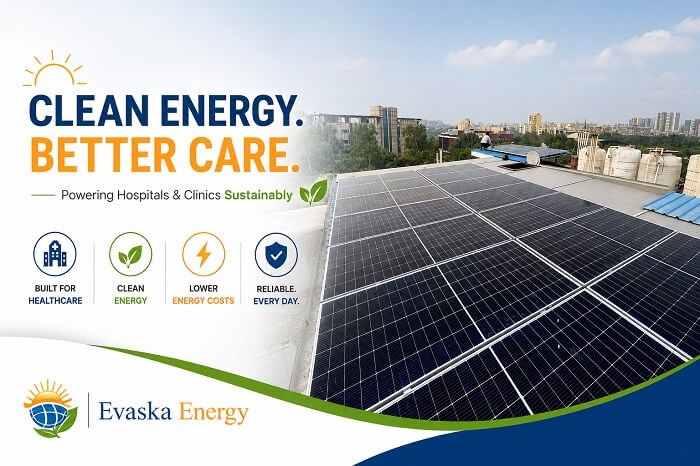
Most solar energy discussions are usually focused on factories, warehouses, or commercial office spaces. While the core principles of solar installation remain similar, hospitals and clinics operate under an entirely different level of responsibility. A manufacturing unit may be able to tolerate a temporary power interruption without major consequences, but healthcare facilities cannot afford even brief disruptions in critical areas such as ICUs, operating theatres, diagnostic labs, or vaccine cold storage units.
Solar systems for hospitals and clinics must address three equally important priorities: reducing operational energy costs, ensuring reliable power support, and maintaining compliance with healthcare and electrical safety standards. A well-designed solar installation must carefully balance all of these requirements together to support uninterrupted healthcare operations while also improving long-term energy efficiency and financial stability.
Why Healthcare Facilities Are Actually a Different Conversation
Most solar guides are written for factories or office buildings. And look, the fundamentals are the same, but a hospital has needs that those places simply don't.
Think about it this way — a textile unit can tolerate a 20-minute outage. Your ICU cannot. Your operating theatre cannot. Your cold storage for vaccines definitely cannot.
So when we talk about solar for clinics and hospitals in Gurgaon, we're really talking about three things at once: energy savings, power reliability, and regulatory compliance. All three matter. And the system you design has to respect all three.
First, Understand Your Load — Really Understand It
Your bill tells you how much energy you used. For a hospital, you need to map three categories:
- Critical Loads: What Can Never Go Down: OT lights, ventilators, monitoring equipment, ICU systems. These need to stay powered through a battery or dedicated inverter circuit, no matter what. No exceptions, no compromises.
- Essential Loads: What Should Stay On: Sterilization units, pharmacy refrigeration, blood bank storage, nurse stations. These should stay on but can tolerate brief interruptions if absolutely necessary.
- Comfort Loads: Where the Savings Are Biggest: HVAC, general lighting, administrative areas. These can flex. In fact, this is where solar savings are often the biggest, because AC systems run hard during the day when solar generation peaks.
What Kind of System Makes Sense Here
For most hospitals and clinics in Gurgaon, there are three configurations worth considering — and the right one depends on your specific situation.
- Grid-Tied with Net Metering: This is the most straightforward. Your solar panels feed power into your building, you draw from the grid when you need more, and you export surplus to DHBVN (the local DISCOM) and earn credits. Lower upfront cost, faster payback. But — and this is important — if the grid goes down, this system shuts off too. It's a safety feature, not a bug, but it means you still depend on your diesel genset for outages.
- Hybrid System with Battery Storage: This is honestly where most healthcare facilities land when they think it through. You get the grid-tied savings plus a battery bank that keeps your critical loads running during outages. The batteries charge from solar during the day, and you can configure which circuits they protect. If you're trying to figure out which configuration actually fits your facility, Evaska Energy — a solar installation company in Gurgaon that works specifically with commercial and healthcare setups — can walk you through the options without pushing you toward whatever's most expensive. Costs more upfront, but for a hospital... the peace of mind is real.
- Off-Grid (Rare, But Sometimes Relevant): If you're running a remote clinic or a facility that genuinely can't rely on the grid, off-grid solar with larger battery storage is an option. But in urban Gurgaon? It's usually not necessary, and the economics are harder to justify.
The Numbers — Let's Be Honest About Them
we are not going to throw out a specific rupee figure and tell you "this is what it costs," because honestly, it varies too much. But I can give you a realistic framework.
- System Sizing: A 200-bed hospital in Gurgaon typically has a connected load somewhere between 300-500 kW, with average demand around 150-250 kW. A rooftop solar system of 100-200 kW is a reasonable starting point — enough to meaningfully offset daytime consumption without trying to cover everything.
- Cost Range: Commercial/industrial solar in Gurgaon currently runs roughly ₹45-65 per watt installed, depending on panel quality, inverter type, and whether you're adding batteries. So a 100 kW system might cost ₹45-65 lakh before subsidies.
- Subsidies You Might Not Know About: Here's something a lot of facility managers don't know — commercial healthcare facilities can access PM Surya Ghar benefits in some configurations, and there are state-level schemes under Haryana's renewable energy programs. It's worth having a conversation specifically about this, because the subsidy landscape changes and a good installer will know what's currently available.
- Payback Period: Typically 4-7 years for a well-designed system in this segment. After that, you're essentially generating free electricity for 20+ years. And with electricity tariffs only moving in one direction
Important Realities You Should Know Early
- Monsoon Performance Is Better Than You Think: Gurgaon gets real cloud cover June through September, but modern panels generate in diffused light too. You'll see reduced output, not zero output.
- Cleaning Matters More Than You'd Expect: Gurgaon's air quality means panels accumulate dust quickly. Build a cleaning schedule into your AMC — monthly at minimum, fortnightly during summer.
- Your Generator Still Has a Role: Solar plus batteries reduces generator runtime dramatically, but for extended outages (multiple days, rare but possible), diesel backup remains your last line of defence. Think of solar as your first responder, the generator as your insurance policy.