Solar Panel Maintenance Cost Tips Best Practices India
Solar panels are one of the lowest maintenance investments you can make - but low maintenance doesn't mean NO maintenance. A system can go from 5% to 30% reduction in generation capacity because of dust, bird droppings and grime on the glass - without any action. The money left on your roof for a warranty of 25 years.
This guide explains everything you need to know about maintaining your Indian rooftop solar system at peak performance - how often you need to clean it, how to do it safely, what a full annual service entails, how much it will cost you and how to get your solar panels to perform for a full 25 years.
The importance of solar panel maintenance
A solar panel has no moving components, hence no mechanical wear. What really happens is easier and sneakier: dust, pollen, bird droppings and pollution settle on the glass surface, and act to block sunlight from reaching the cells underneath. There's a direct correlation between less light in and less electricity out.
- This is no small effect in Indian conditions of high dust, dry spells in-between monsoons, and high pollution levels in urban centres like Delhi, Noida and Gurgaon.
- During dry, dusty months, the output of uncleaned panels can be reduced by 5-20%.
- With panels left entirely uncleaned for a month or more the 30% loss per year is by no means uncommon in extreme cases.
- After a lengthy dry period, one complete cleaning will return 20-25% of lost generation almost instantly.
In addition to a loss of output, dirt on one part of a panel can also cause localized heating (hot spots) which stresses the individual cells below, resulting in permanent damage rather than just a short-term drop in efficiency. So, this is really a two problem in one; loss of electricity today and a shortened panel life tomorrow.
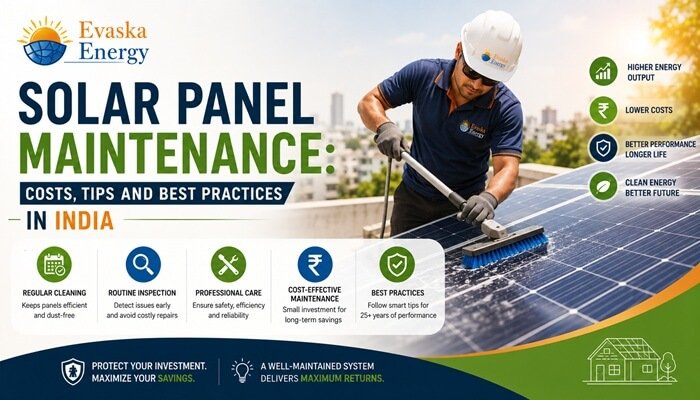
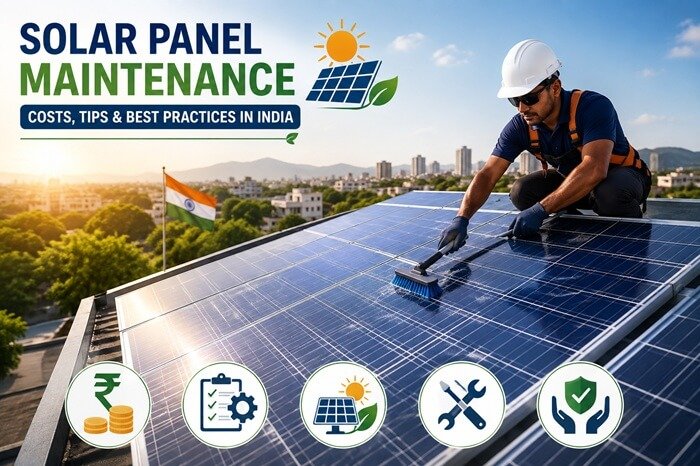
How to clean solar panel yourself step by step:
While cleaning solar panels is simple enough, there are a few safety and technique considerations to keep in mind, in case you crack the glass or damage the components below; this can render the panel useless. Before you start:
- Turn Off the Isolator: If cleaning the solar system during daylight hours, turn it off at the isolator/switch prior to cleaning. This will help to safeguard you and avoid partial shading problems while you are at work.
- Time it right: clean in the early morning before the sun rises or at night after the sun has set when panels are cooler. Do not spray hot panels with cold water as this could cause the glass to crack.
- Prepare your materials: just plain water (a hose or pipe will suffice), a soft sponge or microfiber cloth and a telescopic rod if the panels are inaccessible. It's as simple as that - no fancy required.
While cleaning:
- Use only plain water. If the soap or detergent isn't specifically recommended by your panel manufacturer, or any third party chemical cleaner, you should avoid using it, or else it may cause degradation of the anti-reflective coating and permanently lower efficiency.
- Only clean the upper surface of the glass. Avoid spraying water on the bottom where cables and junction box are located.
- Be sure to use a soft sponge or cloth and not anything coarse, sharp or metallic. Scratches on the glass will stay there and will decrease the output of the panel for its lifetime.
- Do not stand, sit or kneel on the panels, nor place tools or equipment on the panels.
- Use ladders correctly and always wear a safety harness to work at height, don't rush to get up there.
- The soap and water: ordinary dust can be controlled with plain water. Its effectiveness is less for tough grime, but the safety and warranty liability risk of using the wrong type of cleaning method is almost always much greater than the cleaning benefit - if in doubt, use water or hire a professional.
Automatic Cleaning Systems: Are They Worth It?
For larger commercial rooftop or ground-mounted systems, automated sprinkler cleaning is a viable option if manual cleaning is too cumbersome. These systems consist of a network of pipes and nozzles spraying a fine mist of water across the panels at a pre-set time (or on demand), so as to remove dust and droppings without any risk to people climbing on the roof.
The balance is simple: more expensive (and higher upfront) but very little ongoing labor (and always clean panels year-round when someone remembers, not when they need to be). Larger residential systems (5kW+) or commercial rooftops that are inaccessible or expensive to reach may make the payback a worthwhile. Manual cleaning every few weeks is generally a cheaper option for an easy to access small home system.
Beyond Cleaning - What Full Solar Panel Maintenance really means
Cleaning is what everyone thinks about, but a proper maintenance visit once a year goes beyond that - more of a full health check for your system!
- Visual and structural inspection - inspect the mounting structure for rust, loose bolts or damage to the frame structure
- Inspecting and verifying all electrical junctions, cables and wiring are secure and in good condition
- Electrical connection testing - ensuring that the wiring connecting to the inverter is in good condition, as one of the most frequent problems can be caused by the inverter.
- The measurement of the earthing value is a safety measure that is frequently not highlighted when using a DIY method.
- Performance monitoring - which involves comparing the actual generation with the expected generation to detect degradation at an early stage.
- Underperformance diagnostics such as IV curve tracing and thermal imaging for larger systems to identify failing cells before they are a problem
This is the sort of work that only a trained professional would undertake because it is not difficult to clean, but rather difficult to diagnose electrical and structural problems safely without the proper equipment and training.
Cost of Solar Panel Maintenance in India
This is the question most guides avoid - here's it:
DIY Cleaning:
If you have safe roof access, water and a small residential system, do it yourself - It's effective, and it's free except for your time. Most residential roof-top systems use this option, both on one and two-storey buildings.
Professional cleaning:
Professional cleaning is available for homes where it is not easy to get on the roof, or for those who do not want to clean the roof themselves, as a standalone service or part of an AMC (Annual Maintenance Contract). The price depends on system size, location and the number of visits per year, the total cost will vary, so contact your solar service provider or installer for a specific quote - prices can differ significantly from one place to another and by system size.
Annual Maintenance Contracts (AMC):
Most solar installers, including Evaska Energy, provide AMC packages that include regular cleaning and the full list of inspections above: Inverter, Structural, and Performance Monitoring. An AMC is typically worth it when:
● If you have a larger system (5kW+) and it is truly hard to get into for cleaning, then it is more appropriate to hire a professional for the job.
● You need warranty coverage - many manufacturers require proof of routine maintenance and an AMC does this for you automatically
● You don't want to have to manually schedule cleaning and deal with a tech as needed
The actual expense you'll have to consider is not the AMC fee, but the expense of not getting the maintenance done at all. Even if a system loses just 10% of its output to dust, it is losing real electricity generation every day that it goes uncleaned. That difference in generation is typically greater than the value of a simple cleaning-only AMC for a typical residential system over a year. Failure to perform maintenance can also result in loss of manufacturer's warranty coverage, potentially creating a very costly maintenance issue if a component fails after the warranty period has expired.
Factors That Affect Long-Term Panel Efficiency
A system will perform well when it is well-maintained, but there are some structural aspects that limit the performance of the system:
- Orientation - South facing installations receive the most steady sun exposure throughout the Indian latitudes, and East/West orientations will also produce a certain amount of steady sun exposure.
- The angle of tilt - approximately 25-35° is considered ideal for Indian latitudes, but this can vary by location.
- Shading (whether partial or full) from trees, buildings, rooftop structures, etc. can reduce output by up to 25-50%, more than the shaded area would imply.
- Temperature is a factor - panels actually lose a little efficiency in very hot environments, but gain in efficiency in hotter conditions in general.
- Cleanliness - Keep it neat and clean
How to Maximize Your Solar Panel's Lifespan
The typical solar panel has a 25-year performance warranty, which isn't a marketing figure, but a reasonable one when you take care of your solar panels. There are a couple of factors that will really make it or break it:
- Installation: Even if the panels are of the highest quality, a poorly installed system (due to poor mounting, incorrect cabling, incorrect wind-load calculations) can reduce effective system life by 20-25%. This is the one most important factor to consider when hiring a professional installer, as opposed to the lowest quote available, and it's one that's registered with the MNRE.
- Expect gradual, normal degradation: This is not a defect, but the normal decay rate of panels, which is approximately 0.8% loss of output per year as specified in all manufacturers warranties. Even a well-maintained system should be able to achieve 90%+ of its original production after 20 years.
- Maintain panels in good shape and structure.
- Monitor generation regularly: Most installers offer a monitoring app, use it! Whether it's a drop in output due to dirt accumulation, a loose connection, or an inverter fault, a sudden decrease in output is usually the first indication of a problem.
- Keep your maintenance documented: If your manufacturer's warranty includes maintenance guidelines, a documented AMC history can help substantiate your claim in case of problems (many do).
Do It Yourself or Call in the Professionals?
Most home systems are okay with do-it-yourself cleaning. Call in a professional when: The problem cannot be solved by simply cleaning (Loose wiring, inverter fault, structural damage, generation drop due to cleaning)
- Your access to the roof is truly unsafe without training or equipment to do so.
- Your panels come with a warranty which includes the maintenance of the panels and requires professional documentation.
- It's time for the once-a-year complete inspection; electrical, structural, and performance testing are not something that can be done by the homeowner using common tools, and it requires proper equipment to do it correctly
There's no need to be daunted or cost-averse about solar panel maintenance in India - A simple water wash every few weeks will take care of most of it, and it's a task that can be done safely by almost any homeowner with a bit of foresight and caution. A system that is cleaned regularly and inspected annually will provide its full rated output, generation, and warranty coverage for 25 years, while one that is neglected will lose generation, money, and even warranty coverage quietly over time.
When you don't want to handle the schedule yourself, an AMC from a qualified installer will include cleaning with the entire inspection list, maintain warranty documents and remove the guesswork from when your system needs attention.