Why Homeowners Choose Hybrid Solar
Ten years ago, going solar in Delhi NCR meant one simple question: how many panels fit on the roof? Today, homeowners are asking something different. They want to know whether solar will keep the house running when the power goes, whether it can replace the old inverter in the stairwell, and whether it will still make sense when they buy an EV or add another AC.
That shift is why hybrid solar – rooftop panels plus a battery plus your normal grid connection – has become one of the most requested systems at our site visits across Delhi, Gurgaon, Noida, Ghaziabad and Faridabad. Below are the real reasons homeowners choose it, what it replaces, and the cases where we advise people not to.
What makes a solar system "hybrid"?
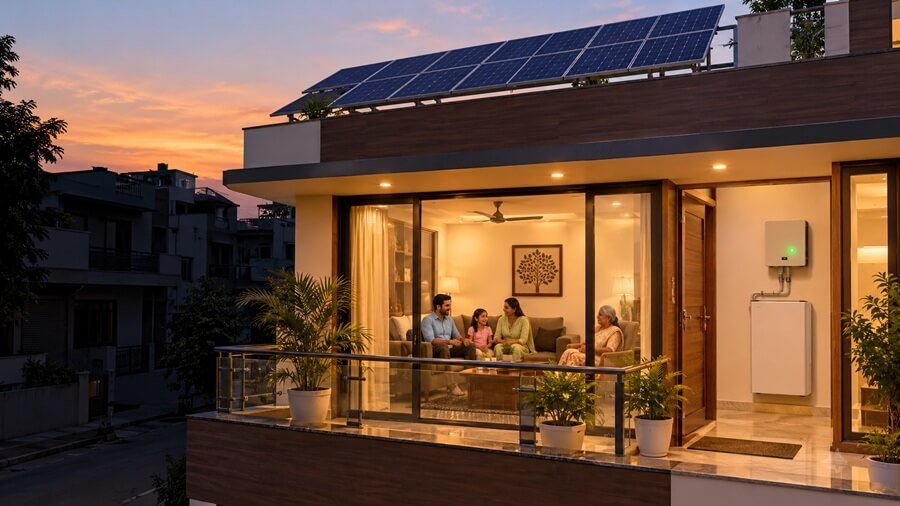
A hybrid system uses a hybrid inverter that manages three sources together: solar panels, a battery and the grid. During the day, solar runs your home and charges the battery, and extra power can go to the grid under net metering. During a power cut, the battery takes over automatically. A normal on-grid system can't do this – it shuts down when the grid fails, even in full sunshine. For a detailed technical guide, read our hybrid solar system guide for 2026.
8 reasons homeowners choose hybrid solar
1. Power cuts are still part of life in many areas
Outages in newer Gurgaon sectors, Greater Noida, Ghaziabad, Faridabad and outer Delhi can run from a few minutes to several hours, especially during summer peaks and storms. Families with hybrid solar don't notice most of them – lights, fans, Wi-Fi and the fridge keep running from the battery.
2. Work from home and online classes can't stop
A dropped video call or a lost Wi-Fi connection now costs real money or a missed class. Many of our hybrid customers chose it mainly for one room: the home office.
3. They want to replace the old inverter and tubular batteries
The traditional home inverter only stores grid power and needs battery water top-ups, takes floor space and gives off hydrogen while charging. A hybrid system with a lithium battery is sealed, wall-mounted, maintenance-free and charges from the sun instead of your bill.
4. Lower bills without giving up backup
Homeowners used to choose between saving money (on-grid solar) and backup (inverter or generator). Hybrid gives both. The solar part reduces your bill exactly like an on-grid system, and net metering still credits extra units.
5. Elderly parents and medical equipment
For families with a CPAP machine, oxygen concentrator or bedridden parent, a power cut isn't an inconvenience – it's a worry. A hybrid system with a reserved battery level gives them reliable backup without depending on a DG set.
6. Getting away from diesel generators
Generators are noisy, need fuel and maintenance, and in Delhi NCR their use is restricted during GRAP in winter. Kothis and large builder floors that used to run a DG set during cuts are increasingly switching to battery backup.
7. Planning for more ACs and an EV
Household consumption keeps rising. A hybrid inverter lets you start with the solar and battery you need now, then add panels or battery later within its limits, without rewiring the house.
8. Solar got cheaper
Since 22 September 2025, GST on solar panels and solar power equipment has been 5% instead of 12%. The PM Surya Ghar subsidy (up to ₹78,000 for homes) still applies to the solar part of a grid-connected hybrid system. Together, these have made adding a battery far more affordable than it was a few years ago.
Old inverter vs hybrid solar: what changes
| Home inverter + tubular batteries | Hybrid solar + lithium battery | |
|---|---|---|
| Charges from | Grid only (adds to your bill) | Solar first, grid only if needed |
| Effect on electricity bill | None, or slightly higher | Lower – solar plus net metering |
| Maintenance | Distilled water, terminal cleaning | None for the battery; panels need rinsing |
| Battery life | Usually 3–5 years | Typically 8–12 years |
| Space | Floor space, needs ventilation | Compact, wall-mounted |
| Can run an AC on backup | Rarely | Yes, if sized for it |
| Phone monitoring | No | Yes – solar, battery and grid in one app |
When hybrid solar is NOT the right choice
We don't recommend hybrid to everyone. It costs more than on-grid because of the battery and hybrid inverter, and the battery will need replacing once during the panels' 25-year life. Choose a plain on-grid system instead if:
- Your area almost never loses power – much of central and south Delhi has very reliable supply.
- Your only goal is the lowest bill and fastest payback.
- Your budget is tight – start with on-grid now and choose a hybrid-ready inverter so a battery can be added later.
What homeowners wish they had known before buying
- Battery size decides backup, not panel size. A 5 kW solar system with a small battery still gives short backup.
- Not everything should be on backup. Geysers, heaters and multiple ACs drain a battery fast. A separate backup circuit for essentials keeps costs sensible.
- Compare usable kWh, not the number on the box. Lithium gives 80–95% usable capacity; lead-acid gives about 50%.
- Check inverter–battery compatibility. Many hybrid inverters only work with certain battery brands.
- Builder floors need terrace consent. Get it in writing before installation.
FAQs
Why are hybrid solar systems becoming popular in India?
Because they combine bill savings with backup during power cuts. Falling lithium battery prices, the GST cut on solar equipment and the PM Surya Ghar subsidy have also made them much more affordable for homes.
Is hybrid solar worth it for a flat in a high-rise?
Individual flats rarely have their own roof space. The practical option is common-area solar through the RWA. If you live in an independent house or builder floor with terrace rights, hybrid is a good fit.
Can I keep my old inverter after installing hybrid solar?
A hybrid system replaces the old inverter's job, so most customers remove it. Old tubular batteries usually can't be reused with a modern hybrid inverter designed for lithium.
How much more does hybrid cost than on-grid solar?
The extra cost is mainly the battery and hybrid inverter. A 5 kWh lithium battery alone typically costs around ₹1–1.2 lakh in 2026, so the exact difference depends on how much backup you want.
Do I lose the government subsidy if I choose hybrid?
No. A grid-connected residential hybrid system can still get PM Surya Ghar subsidy on the solar part if it uses DCR panels, a registered vendor and approved net metering. The battery itself is not subsidised.
Wondering whether hybrid or on-grid suits your home? Evaska Energy will check your power-cut pattern, bills and roof, and tell you honestly which one gives you better value. Call 096507 28179 for a free site visit anywhere in Delhi NCR.