Agrivoltaics in India
Can the same farmland grow crops and generate electricity? India is betting it can.
In October 2026, agrivoltaics moved firmly onto the national agenda. The Union Minister for New and Renewable Energy, Pralhad Joshi, announced that the next phase of PM-KUSUM will carry a major agrivoltaics programme. In the same week, New Delhi hosted the world's biggest gathering on the subject.
The minister summed up the idea in four words: the Annadata (food giver) can now become an Urjadata (energy giver). In this guide, we explain what agrivoltaics is, what the government has announced, and what it could mean for farmers in Haryana, Uttar Pradesh, Rajasthan and across India.
What is agrivoltaics?
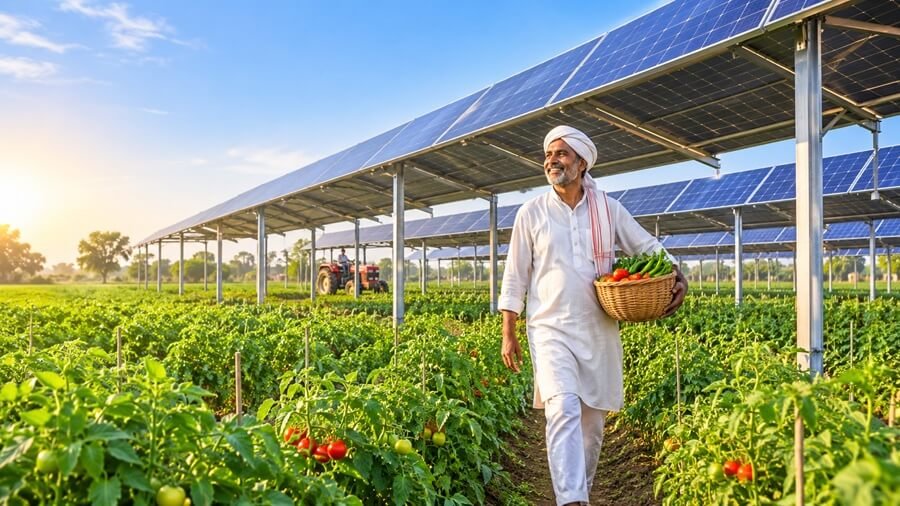
Agrivoltaics (also called AgriPV or agri-solar) means using the same piece of land for farming and solar power at the same time. Instead of covering a field with ground-mounted panels, the panels sit on raised structures, or stilts, high above the crops.
Here is how it works in practice:
- Raised panels: structures are tall enough for farmers, workers and machinery such as tractors to move underneath.
- Spaced rows: panels are spread out so enough sunlight reaches the crops below.
- Partial shade: crops get relief from harsh afternoon sun, and the soil holds moisture longer.
- Two outputs: the farmer harvests crops as usual, while the panels supply electricity to the farm or to the grid.
A conventional solar plant needs about 4 acres of land for every 1 MW. In a land-scarce country like India, agrivoltaics avoids choosing between food and energy.
India's big push: what was announced
1. A dedicated agrivoltaics programme under PM-KUSUM
Speaking on 21 October 2026, Pralhad Joshi said the government will launch "one of the world's most ambitious agrivoltaic programs" under the next phase of PM-KUSUM Yojana. Earlier in 2026, he had said PM-KUSUM 2.0 would include a dedicated 10 GW Agri-PV component.
MNRE Secretary Santosh Kumar Sarangi said the target is 5 GW over the next few years to begin with. A draft agrivoltaics policy will be released for feedback from states and stakeholders.
The first PM-KUSUM phase built a strong base. More than 1 million feeder-level installations had been solarised by November 2025.
2. A global conference in New Delhi
India hosted the 7th Agrivoltaics World Conference at Bharat Mandapam from 21 to 23 October 2026, under the theme "Powering the Global South". It was the first time the conference was held in the Global South.
More than 1,500 participants from over 40 countries attended, including around 400 farmers. The conference was inaugurated by Pralhad Joshi and Agriculture Minister Shivraj Singh Chouhan.
3. New policy tools
MNRE released an AgriPV Policy Handbook at the conference. Alongside it came the India Agrivoltaics Alliance's Decision-Making Tool and a Book of Abstracts from the International Water Management Institute. These help states and developers choose suitable sites, crops and project designs.
4. Support for higher costs
Raised structures make agrivoltaics more expensive. Agri-PV plants cost about 25 to 30% more than conventional ground-mounted solar. Power from them could cost ₹3.20 to ₹3.30 per unit, against ₹2.50 to ₹2.60 for ground-mounted plants.
The government is exploring incentives to close this gap, much like the solar subsidy under PM Surya Ghar for rooftops. The minister also expects costs to fall with scale, as they did for regular solar.
Why agrivoltaics matters for India
Huge potential. About 47.5 million hectares, roughly 30% of India's 160 million hectares of cropland, is technically suitable for agrivoltaics. Maharashtra, Rajasthan, Andhra Pradesh, Madhya Pradesh, Karnataka and Uttar Pradesh together hold nearly half of it.
Better yields for some crops. Field studies show yield gains of 10 to 20% for certain crops under partial shade, along with about 30% water savings and healthier soil.
A second income for small farmers. More than 85% of Indian farmers are small and marginal, farming less than two hectares. The minister described three income streams from the same acre: crop earnings, revenue from electricity sold to DISCOMs, and savings on diesel. Surplus power can also earn credits through net metering.
Land without conflict. India has around 18% of the world's population but only 2.4% of its land. Agrivoltaics lets solar capacity grow without taking land away from food.
Benefits and challenges at a glance
| ✅ Benefits | ⚠️ Challenges |
|---|---|
| Crops and power from the same land | 25–30% higher setup cost than ground-mounted solar |
| Yield gains of 10–20% for suitable crops | Not every crop grows well in partial shade |
| Around 30% less irrigation water | Structures must leave room for tractors and harvesting |
| Extra, stable income from electricity | Scheme timelines and subsidy amounts not yet announced |
| Less heat stress on crops and soil | Needs careful design: height, spacing and panel angle |
The challenges are real, but most are design questions. The Agriculture Minister has stressed that farmers must be able to keep cultivating. Projects need the right panel height, spacing between supports and room for farm machinery. Flexible solar EMI plans can also ease the upfront cost.
The challenges are real, but most are design questions. The Agriculture Minister has stressed that farmers must be able to keep cultivating. Projects need the right panel height, spacing between supports and room for farm machinery. Flexible solar EMI plans can also ease the upfront cost.
Which crops suit agrivoltaics?
Shade-tolerant crops do best under panels. TERI's crop suitability work finds horticulture crops the best fit, and field studies report the strongest gains for fruits and leafy vegetables.
Crops often trialled under panels include:
- Leafy vegetables: spinach, lettuce, coriander, fenugreek (methi)
- Vegetables: tomatoes, chillies, capsicum, cabbage
- Root and spice crops: turmeric, ginger, potatoes
- Fruits: strawberries and some shade-loving fruit crops
Tall cereal crops that need full sun, such as wheat and paddy, are usually harder to fit. ICAR has called for crop matrices suited to each of India's 15 agro-climatic zones. Check with your local Krishi Vigyan Kendra before choosing crops.
How farmers can get ready
Timelines and funding details for PM-KUSUM 2.0 are still to be announced. But the direction is clear: farmers can become energy producers too. You can prepare now.
- Check your land records and confirm ownership or lease terms.
- Note your electricity use, including pumps and diesel costs. Our solar savings calculator shows what solar could save.
- Pick crops that tolerate partial shade, with advice from your local KVK.
- Get a site assessment of sunlight, soil, layout and grid connection.
- Watch for state notifications under PM-KUSUM 2.0 and the upcoming agrivoltaics policy.