25kW Solar System Price in India
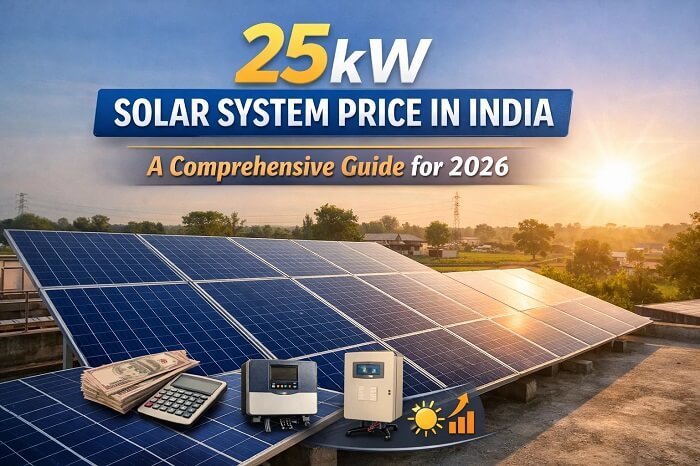
Renewable energy is constantly changing, and a 25kW solar system can be a great solution for commercial buildings, small factories, or big apartments in India. By the year 2026, electricity prices have been increasing, and there are different government schemes to encourage solar energy. Hence, users benefit from investing in solar energy in both ways reducing their electricity expenditure and helping the environment. A 25kW system is capable of producing a maximum of 100 units (kWh) per day which can be around 3,000 units monthly and 36,000 units annually, of course, it also depends on the geographical location and the number of sunlight hours. This comprehensive guide goes into the details of prices, panel technologies that vary such as HJT, TOPCon, bifacial, and mono PERC, and types of systems (on-grid, off-grid, and hybrid). Additionally, the article discusses subsidies, the most important factors for cost, and provides guidance on making a smart choice.
Understanding the Basics of a 25kW Solar System
A 25kW solar system would generally occupy a rooftop or a ground area of about 150-200 square meters without any shade. The major elements are solar panels (with a combined capacity of 25kW), inverters, mounting structures, batteries (only for off-grid or hybrid), cables, and BoS (Balance of System) items like junction boxes and fuses. The overall price mainly depends on the quality, brand, and setup, but as a rough estimate, it might be between ₹10-20 lakhs. Efficient solar panels from well-known brands like Tata, Waaree, or Adani can increase the energy production, and adherence to MNRE (Ministry of New and Renewable Energy) and ALMM (Approved List of Models and Manufacturers) norms gives you the advantage of receiving incentives.
The system generally takes 4-6 years for the investor to recover the initial cost and then it can be used for over 25 years with little maintenance. In places with high sun exposure such as Rajasthan or Gujarat, the investment gets recouped much quicker due to higher output.
Price Breakdown by System Type
There are three main types of solar system designs, each one is tailored for different requirements:
On-Grid Solar System: An On-Grid Solar System is directly connected to the utility grid; through net metering the user can export excess electricity and get credited for it. This is the cheapest option for places with good grid connection as there is no need for batteries.
-
Average Price in 2026: ₹11.25 lakhs to ₹13 lakhs (₹45-52 per watt). It consists of panels, three-phase inverter (e.g., 25kW models from Fronius or Growatt at ₹85,000-₹1 lakh), mounting, and installation.
-
What Makes It Attractive? It is perfect for commercial consumers who want to reduce their high electricity usage during the daytime. There is no power supply during grid failure, but the good thing is that the net metering credits can lessen your bills by 70-90%.
Off-Grid Solar System: An Off-Grid Solar System is powered by its energy only and the batteries are charged during the day so that the power can be used when there is no sunshine or the grid is down. Such a system is best for places far away or where the power is often cut off.
- Average Price in 2026: ₹16.75 lakhs to ₹18 lakhs (₹67-72 per watt). Lithium-ion batteries (around 40-50kWh storage) can cost ₹4-6 lakhs and thus the total price goes up.
- What Makes It Attractive? The user enjoys complete energy independence but the downside is that the battery bank needs to be super-sized for the less sunny days which results in a higher upfront cost.
Hybrid Solar System
The Hybrid Solar System offers a combination of the grid and battery storage; therefore it can utilize any of them as the source of power. Besides using the power saving feature, it also allows power backup during the time of power outage.
- Average Price in 2026: ₹19.5 lakhs to ₹21 lakhs (₹78-84 per watt). Comes with modern hybrid inverters (e.g., Deye 25kW at ₹1-1.5 lakhs) and batteries.
Why Choose It?
Perfectly matches industries with critical loads that require uninterrupted power. Utilizes smart energy management to achieve maximum savings. Prices exclude GST (5-18%) and may vary by location - urban installations in Delhi & NCR cost 10-15% more due to labor.
Prices by Solar Panel Technology
The choice of panel affects a lot - the potential output, lifespan, and the price. A 25kW system requires around 40-60 panels (depending on wattage, e.g., 400-600W each). Here's a per-watt breakdown for 2026:
- HJT (Heterojunction) Panels: HJT Solar panels are a hybrid of crystalline and thin-film technologies and offer remarkable efficiency (up to 23-24%) and very low degradation (0.4%/year). These panels are especially suitable for hot climates and also have better performance in low light.
- Unit price per kW: ₹23,000-₹35,000 (₹23-35 per watt). 25kW would be: ₹5.75-8.75 lakhs (only panels).
- Advantages: High output (5-10% more than regular), 30-year warranty. Examples of HJT from Reliance Solar with 730W modules are available.
- Disadvantages: 10-20% more expensive than alternatives.
- TOPCon (Tunnel Oxide Passivated Contact) Panels: Topcon Solar Panel, the rising star, packs 22-24% efficiency while minimizing losses. Usually, they make use of the rear-side light to increase the output.
-
The price per kW ranges between ₹16,000-₹25,000 (₹16-25 per watt). For 25kW: ₹4-6.25 lakhs.
-
Benefits: An economical premium option, extremely low LID (Light-Induced Degradation). Waaree and Adani are the major players.
-
Drawbacks: Slightly more expensive than mono PERC.
-
- Bifacial Panels: Bifacial panels can produce electricity from both sides, thereby increasing output by 10-30% when used on reflective surfaces such as white-painted roofs.
- Unit price per kW: ₹20,000-₹30,000 (₹20-30 per watt). For 25kW: ₹5-7.5 lakhs.
- Advantages: Great for use on ground-mount or raised structures. By and large, combined with TOPCon/HJT.
- Disadvantages: Maximum yield requires appropriate inclination and albedo.
- Mono PERC (Passivated Emitter and Rear Cell) Panels: The conventional choice among price-sensitive buyers, with 19-21% efficiency and decent reliability.
-
Cost per kW: ₹22,000-₹28,000 (₹22-28 per watt). For 25kW: ₹5.5-7 lakhs.
-
Pros: Cheap, easy to get. Tata and Vikram Solar provide dependable offers.
-
Cons: Degrades faster (0.5-0.75%/year) than the cutting-edge tech.
-
HJT or TOPCon advanced panels mean shelling out 15-25% more than standard panels but these panels will produce 10-20% more energy thus shortening the payback period.
Subsidies and Incentives for 25kW Systems
Extension to 2026 of PM Surya Ghar: Muft Bijli Yojana allows residential consumers to avail Central Financial Assistance (CFA): ₹30,000/kW up to 2kW, ₹18,000/kW for 3kW, with a ceiling of ₹78,000 for bigger systems. Subsidies would be greatly limited for a 25kW system (usually commercial) - maximum ₹78,000 if it's residential. The commercial sector may be eligible for other incentives like accelerated depreciation (40% in year 1), state subsidy, or low-interest loans through IREDA.
Additional top-ups are available in certain states like Delhi (₹10,000/kW up to 3kW) or Uttar Pradesh. Selling surplus power through net metering at ₹3-5/unit is also possible, which further reduces the effective cost. Always verify through the national portal (pmsuryaghar.gov.in) whether you meet the criteria.
Factors Affecting the Price
- Geographical dependence: Expenses in hilly areas are higher because of transport but lower in solar-friendly areas like Gujarat.
- Referring to Brand and Quality: Tier-1 brands (e.g., Longi, Jinko) come at a premium of 10-15% but bring better warranty.
- Installation: Skilled EPC (Engineering, Procurement, and Construction) costs an extra ₹2-3 lakhs but guarantees safety.
- Extras: Features like monitoring apps, anti-bird spikes, or elevated structures may increase the price by 5-10%.
- Market Forces: Prices have come down since the post-2025 supply chain improvements; however, import duties (40% on modules) keep domestic manufacturers competitive.
Final Thoughts: Is a 25kW Solar System Worth It?
Since the solar capacity in India is expected to reach 300GW by 2030, buying a 25kW solar system is a wise move, and it can possibly save you ₹5-7 lakhs per year on your electricity bills. Go for TOPCon or HJT to gain long-term advantages, and select a hybrid system for dependability. Meet with certified installers, get several quotations, and use subsidies to reduce your expenses. As the necessity of being energy independent is coming to the fore, solar energy is not just profitable in 2026, but it is also indispensable.