FRP vs Magnelis Walkways: Which Is Better for Industrial Solar Roofs
Industrial sheds and large commercial rooftops are considered top locations for solar power generation in India. Usually, hundreds or even thousands of solar panels can be installed on such sites. Still, to maintain the panels' highest efficiency and solar cells' longer life, cleaning, inspection, and maintenance must be done regularly and safely. Walkways installed between the rows of the panels are a great help in such cases and thus their materials' choice affects not only durability and safety but also the overall system's ROI.
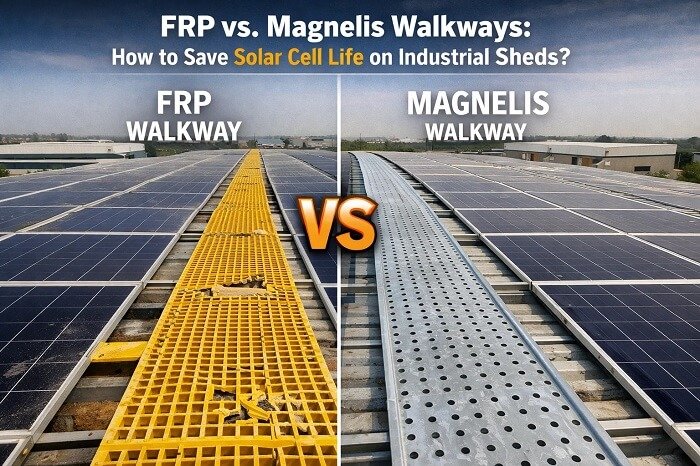
Nowadays, two great alternatives are debated mainly: fiberglass-reinforced plastic (FRP) and Magnelis-coated steel walkways. Though galvanized steel still looks like the main counterfeit, these new substitutes provide better corrosion protection, less structural stress, and further cell efficiency maintenance. Here we are going to discuss their main points and benefits, as well as how the proper walkway can be your solar investment's hidden guardian.
The Walkways as the Most Important Part of Solar Installation
Panels on rooftop industrial sheds are continuously subjected to dust, bird droppings, pollutants, and weather changes that are extreme in some seasons. If the panels get dirty, their output can drop between 5 and 20%, or even more, if the cleaning is delayed significantly. Walkways are made to give technicians solid, non-slip access to the panels while also limiting the possibility of stepping on them, which would cause micro-cracks and hotspots, thus enabling efficient cleaning & maintenance.
Not only in use, but poor walkways material choices may damage the panels faster: old or corroded structures may put extra stress on the roof or even release chemicals that are harmful to the environment and thus can fail prematurely. FRP and Magnelis, two breakthrough materials, come up against such issues effectively, thus securing the panels and the structure.
FRP Walkways: A New Lightweight, Corrosion-Resistance, and Low-Impact Material
Since FRP walkways are made of fiberglass reinforced with the resin matrices, they have become increasingly used for solar rooftops because of these specific properties.
Being inherently non-corrosive, they resist rust, chemicals, acids, and UV deterioration even in a harsh coastal or an industrial environment. Moreover, they do not oxidize or leach any kind of substances around the vicinity of the panels, which is a normal case for metal-based products. Since FRP is such a remarkably light material – often, it is 70-80% lighter than steel equivalents – it puts less stress on the shed roofs, especially those old ones that have not been designed to support heavy solar installations.
FRP gratings are usually either molded or pultruded with the addition of an anti-skid surface so that the users can always be safe even on a wet walkway. They provide excellent electrical insulation which means no shorts or grounding issues are going to be there even though this is close to a live PV system. Besides, there is almost no maintenance required. There are no paint-related jobs, there is no need to do galvanizing, and the material is hardly going to warp or crack.
Solar-wise, the FRP walkways set no problem at all in terms of air circulation under the panels, thus the heat would dissipate easily and the solar cells would be working at a cooler temperature. It means shorter lifetimes and faster degradation of solar cells which happens at temperatures higher than 25 to 30 degrees Celsius. There are quite a few local suppliers right now that provide non-penetrating clamp-on FRP rooftop solar systems.
Magnelis Walkways: Premium Metal Coating for Extended Product Life
Magnelis is a new generation of coated steel, which has been created by ArcelorMittal as a composite zinc, aluminum, and magnesium alloy coating (3% Mg, 3.5% Al, rest Zn). It is used on steel structural members or gratings, ensuring the surface resistance to corrosion long after hot-dip galvanization has ceased to work.
The magnesium in the alloy forms a stable, self-healing protective layer that covers the cut edges, scratches, and dents - essentially, the first places where ordinary galvanizing gets damaged. Magnelis test results show the material can perform up to an order of magnitude better than galvanized steel in aggressive environments, thus offering a C5 corrosivity class protection for 20+ years with very little maintenance.
So, for solar walkways, the implication is longer structural life without the usual zinc runoff that would otherwise contaminate the panels or the soil (Magnelis has 75% less zinc and drastically reduces the runoff). The long-lasting nature of the finish makes it suitable for industrial sheds which are constantly exposed to pollutants, salty air close to the ports, or chemical fumes. Since steel is significantly stronger that it can be used in thinner sections for the same load-carrying capacity, the weight can be maintained at an acceptable level while still providing very good stiffness.
Magnelis solar walking surfaces use standard hardware for mounting and the same performance is already proven in ground-mounted and rooftop solar farms worldwide including the rapidly expanding solar market in India for low carbon and durable buildings.
Protection of Solar Modules: A Comparative Look
Both FRP and Magnelis are far ahead of traditional galvanized steel but they cant be compared in terms of one is better because their strengths lie in totally different aspects.
FRP is the best choice for those who value lighter weight and being in a very corrosive environment as well. Since it’s non-metallic, it doesn’t cause galvanic corrosion or metallic particle deposition on panels; in addition, its low thermal conductivity keeps the cells cooler. On top of that, FRP is electrically non-conductive which adds to safety during maintenance.
Magnelis is the right choice when you want to combine mechanical strength with edge protection over a long period of time. The self-healing properties of the coating help the material keep its integrity after foot traffic or minor damage for years, and the decreased environmental impact is in line with sustainable solar. In massive installations, because steel is the most commonly known material, designing can be simpler if you take its load capacity into consideration.
The "secret" to a long service life for solar cells lies in keeping them free from contaminants, limiting heat exposure, and safely accessing the system without damaging either the roof or the panels. FRP is often the win for rooftop sheds due to its lighter weight and zero corrosion risk, whereas Magnelis gives you a strong and recyclable metallic option for heavy-duty industrial environments.
Choosing What Works Best for Your Installation
Take into account the specifics of the location: coastal humidity makes FRP the obvious choice for its absolute corrosion resistance; heavy pollution due to industrial processes or a large number of people going in and out would rather be Magnelis' extreme durability... Besides these, the budget, the load-bearing capacity of the roof, and what is locally available will also influence the decision - neither of the two materials is cheap compared to the basic ones, however, they will both eventually pay off faster with less O&M and longer lifespan.
Get a certified EPC provider to help you determine the condition of your shed and the solar layout. India's solar boom is putting industrial rooftops at the center of the action, and therefore, with a cutting-edge, access-making product such as FRP or Magnelis, you are not merely investing in your power yield but also in maintaining that asset's value over a lifetime.Choose wisely, and let your walkways quietly protect the heart of your solar power generation.